VPN Tier List 2026 — NordVPN, Mullvad and Proton VPN
My practical VPN ranking for 2026, based on what I use, recent independent audits, privacy policies and provider track records.
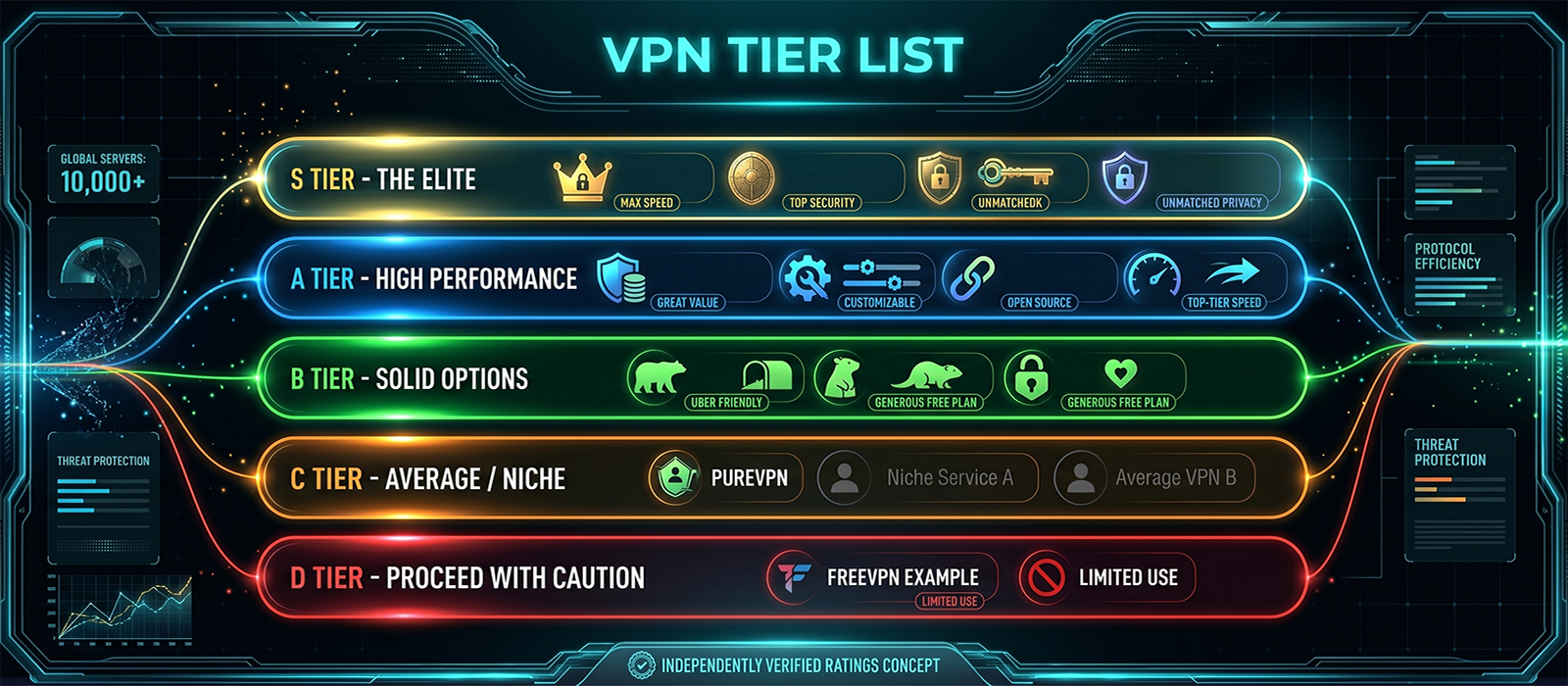
The short version
For my own work and personal devices, I use NordVPN. It keeps passing independent no-logs audits, and its speed holds up on normal connections.
Mullvad is the stronger choice if privacy and anonymous payment matter more than server choice. Proton VPN is the best reputable free option and a good paid alternative.
If you already pay for Revolut, check whether your plan includes NordVPN before buying it separately. The perk varies by country and plan: Premium includes it in the UK and some European markets, while US customers need Metal.
Quick comparison
| Provider | Best for | Starting price | Main caveat |
|---|---|---|---|
| NordVPN | Everyday use and a strong audit record | Varies by subscription term | Lowest price requires a longer subscription |
| Proton VPN | A reputable free tier and open-source clients | Free tier; paid plans vary | Free servers offer fewer locations and features |
| Mullvad | Privacy and anonymous payment | €5/month | WireGuard-only since January 2026 |
| IVPN | Privacy features and multi-hop | From $6/month | Smaller network than the larger providers |
Tier 1 — What I use
NordVPN
NordVPN has a large server network, strong encryption and a consistent record of independent audits.
Why I pick it:
- Based in Panama, outside Five Eyes intelligence sharing
- AES-256-GCM encryption and ChaCha20 on newer protocols
- Annual no-logs assurance work by Deloitte Lithuania since 2022. The latest public report covers fieldwork from 10 November to 12 December 2025 (NordVPN’s 2025 assurance summary). Cure53 also publishes independent infrastructure penetration tests.
- DNS-based threat blocking filters trackers, ads and malicious domains while connected. Broader antivirus features vary by plan and platform.
- WireGuard-based NordLynx protocol for good everyday speed
It is not the cheapest option on its own. That matters less if a service you already pay for includes it.
Revolut plan perk
Revolut is not a VPN provider. It is a financial app that bundles NordVPN with some paid plans.
Availability varies by country. Premium includes NordVPN in the UK and some European markets. In the US, the perk requires the more expensive Metal plan. Check the current benefits in your Revolut app before treating it as a cheaper way to get NordVPN.
If you already pay for an eligible plan, the VPN is a useful extra. If you do not, this is not a reason to open a Revolut account.
Tier 2 — Notable alternatives
Proton VPN
Proton VPN is run by the same company as Proton Mail. It is based in Switzerland, uses full-disk encryption on its servers and publishes its client apps as open source.
Its free tier is limited but legitimate. Paid plans are competitive, and its network now covers more countries and servers than NordVPN’s.
Proton VPN is not Proton Mail. In September 2021, a Swiss court ordered Proton to log the IP address of a specific Proton Mail account linked to a French climate activist. The order concerned email metadata, not VPN traffic. Proton says its reading of current Swiss law means a comparable order cannot force its VPN service to begin logging user IP addresses. That is Proton’s legal position, not a settled court ruling (Proton’s account; Ars Technica’s coverage).
Mullvad
Mullvad costs €5 per month. It does not require an email address, and you can still mail cash in an envelope to pay. It publishes independent audits and owns physical hardware in key locations.
Mullvad removed OpenVPN on 15 January 2026 and is now WireGuard-only. Its server network is smaller than the larger providers, so it is less useful if you need a wide choice of locations for streaming.
Tested under pressure. On 18 April 2023, Swedish police visited Mullvad’s Gothenburg office with a search warrant requested by German authorities. They left without customer data because Mullvad did not have the records they wanted. It was the first such visit in the company’s 14-year history. See Mullvad’s original report, its follow-up naming Germany as the requesting state, and The Verge’s coverage.
A real warrant and nothing to hand over is stronger evidence than a marketing promise.
IVPN
IVPN is based in Gibraltar and takes a privacy-first approach. The client is clean, and multi-hop has been included with every paid plan since May 2026.
Its network is smaller and its higher tiers are expensive for what you get. It suits people who prioritise anonymity over server choice.
Tier 3 — Providers I avoid
Two popular names have track records worth knowing before you trust their marketing.
PureVPN — “no logs” that did not hold
In October 2017, the FBI used connection logs supplied by PureVPN to identify and arrest Ryan S. Lin, a cyberstalking suspect later sentenced to 17 years in federal prison. PureVPN marketed itself as a zero-logging service at the time, but retained originating IP addresses and connection timestamps.
PureVPN told TorrentFreak it had not breached its policy because it logged IP addresses and timestamps rather than browsing activity. See the FBI affidavit, BleepingComputer’s report, and PureVPN’s response reported by TorrentFreak.
ExpressVPN — Project Raven and Kape
On 14 September 2021, the US Department of Justice disclosed that Daniel Gericke, then CIO of ExpressVPN, had entered a deferred-prosecution agreement over his work on Project Raven. The UAE hacking programme built zero-click iPhone exploits used against activists and journalists. Gericke’s individual penalty was $335,000, and he surrendered any future US security clearance.
One day earlier, ExpressVPN had agreed to be acquired by Kape Technologies, then listed on the London Stock Exchange. Kape was previously called CrossRider, an advertising-software company that rebranded in 2018. Kape has since gone private. See the US Department of Justice announcement, Reuters on Gericke’s role, and Reuters on the acquisition.
Ownership and leadership history do not prove that a VPN is unsafe. They do tell you what deserves closer scrutiny.
Why this matters in 2026
Three policy tracks now shape VPN privacy in Europe and beyond.
- EU lawful-access roadmap. The European Commission’s June 2025 roadmap (COM(2025) 349 final) calls for a Technology Roadmap on encryption in 2026 and includes VPNs in its scope. Privacy groups including EDRi and Statewatch have warned that the work could weaken encryption.
- UK Online Safety Act. VPNs remain legal. After age checks took effect on 25 July 2025, Proton reported a 1,800% rise in UK sign-ups, while VPN apps occupied four of the five top free-app positions in Apple’s UK store (The Guardian, 30 July 2025). Proton’s figure is a company report, not an independent measurement.
- India CERT-In rules. Since 2022, VPN providers have had to retain specified customer records for five years and report specified cybersecurity incidents within six hours. The six-hour deadline concerns incident reporting, not handing over five years of logs. NordVPN, ExpressVPN, Surfshark and Proton VPN removed their physical Indian servers rather than keep the required records.
A provider needs both a sound technical setup and a legal base that does not force it to retain sensitive data. Neither is enough on its own.
What makes a VPN worth using
If a provider misses these basics, I move on.
- No-logs policy. Look for repeated independent audits, not a promise on a pricing page.
- Encryption. AES-256-GCM is the baseline. ChaCha20 is also a sound choice.
- Jurisdiction. Where the company is legally based affects what records it can be required to keep.
- Protocol. WireGuard is the modern standard. OpenVPN remains useful where it is still supported.
- Kill switch. If the VPN drops, your real IP address should not leak.
- DNS leak protection. Any VPN worth recommending should include it.
The bottom line
If you do not want to spend a week comparing providers:
- Choose NordVPN for a practical everyday VPN with a strong audit history.
- Check Revolut first if you already pay for an eligible plan.
- Choose Mullvad if anonymous signup and a simple flat price matter most.
- Choose Proton VPN if you want a reputable free tier or prefer a Swiss provider with open-source clients.
Be careful with unknown free VPNs. Running the network costs money, so check how the company pays for it. Reputable freemium services such as Proton VPN Free are funded by paid plans; many no-name alternatives rely on advertising, tracking or other forms of data collection.
This post reflects my own setup as of July 2026. Pricing, features and audit reports change, so check provider sites before subscribing.